Cinétracts by Other Means: Notes from Tehran
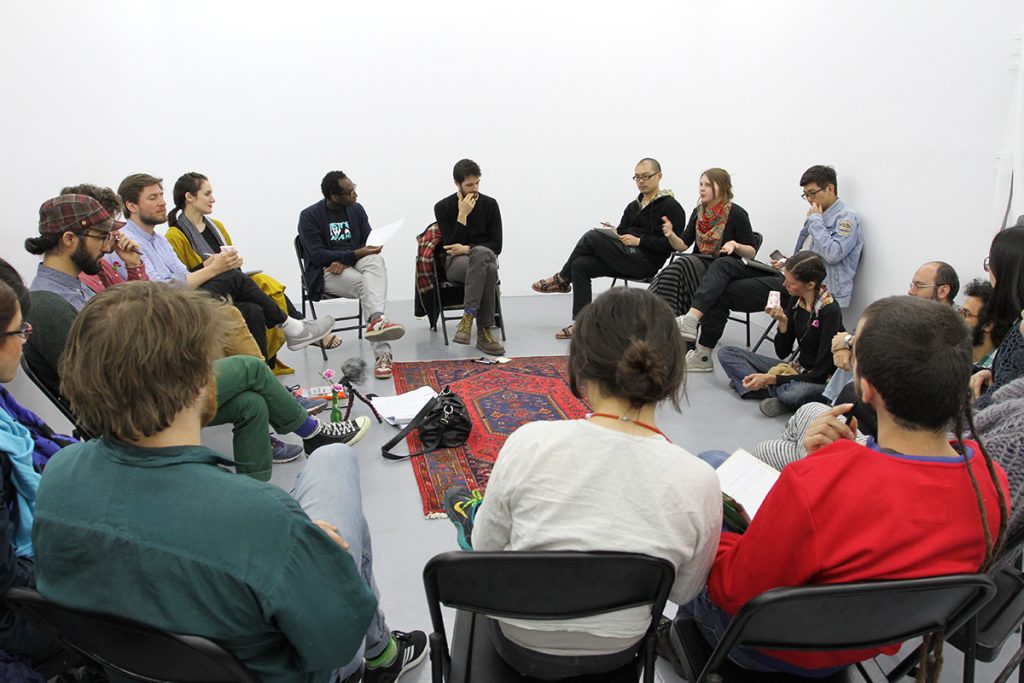
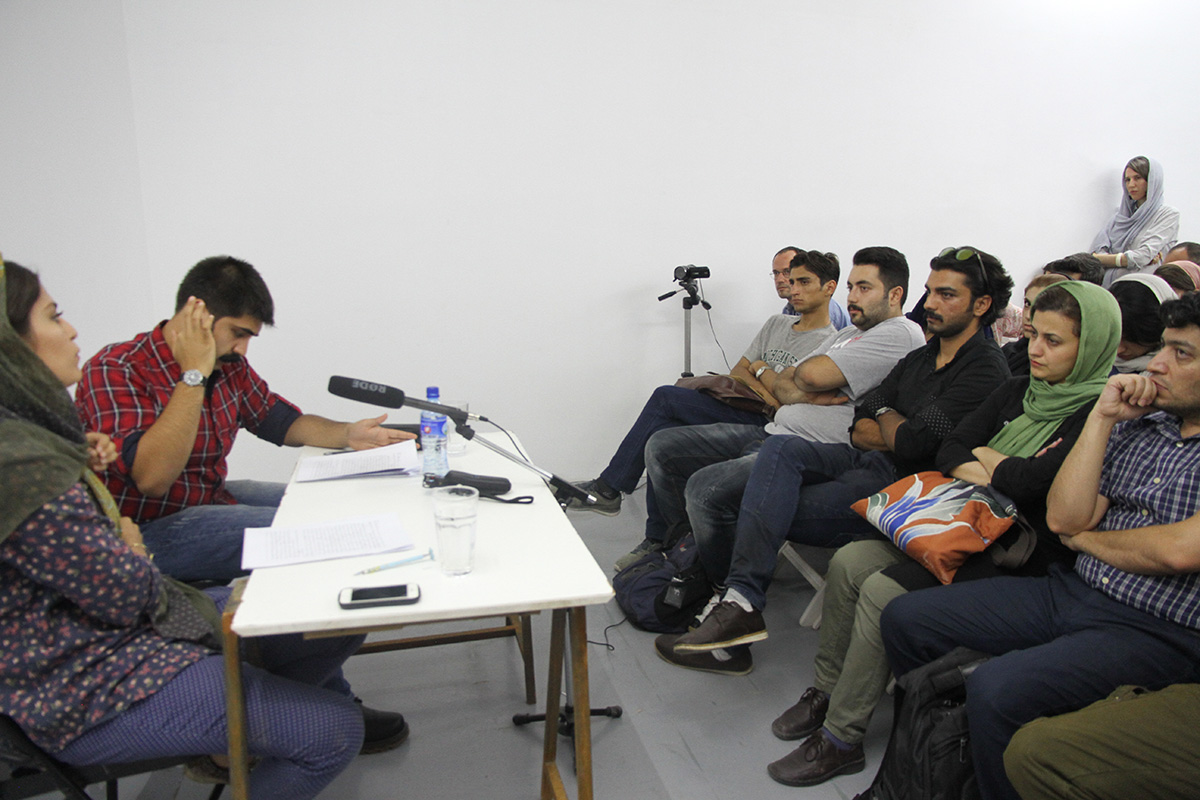
Roaming Academy presents Cinétracts by Other Means: Notes from Tehran with Doreen Mende and The Otolith Group, in collaboration with art research space Sazmanab in Tehran, Sohrab Kashani, and art research graduate Zohreh Deldadeh.
Guest tutors:
Morad Montazami, Marcel Dickhage, Cathleen Schuster, Sandra Schäfer, and Tirdad Zolghadr
Framework:
Doreen Mende (core tutor) in partnership with The Otolith Group, Kodwo Eshun and Anjalika Sagar (project tutors)
Participants, Dutch Art Institute:
Kristinn Gudmunsson, Yung Han Juan, Pilar Mata Dupont, Joost Mellink, Valentina Miorandi, Constanza Puente, Miguel Angel Rego Robles, Peter Sattler, Kaste Šeškeviciute, Celia Shomal, Laila Torres Mendieta, Dai Xiyun, and Hu Wei
Participants, Werkplaats Typografie:
Fred Cave and Yana Foqué
Meetings with:
Sohrab Kashani, Payam Sharifi (Slavs and Tatars), Farid Mostafavi, Hamid Severi, Dariush Mehrjui, and others
The project Cinétracts by Other Means: Notes from Tehran begins with two central concerns. First, it asks how the 1979 revolution in Iran, which overthrew the Shah in order to establish the Islamic Republic, transposed multiple social struggles into domestic spaces that became sites for producing a social fabric shaped both within and against state possession. Second, it examines the questions, proposals, forms, fabulations, methods, and procedures adopted by artists when historical forms of sociality are entangled with contemporary socialities emerging from digital platforms, networks, and the infrastructures of communicative capitalism. The project proposes multiple points of entry into these questions and invites participants to construct relations to their own positions within the framework.
Cinétracts by Other Means: Notes from Tehran is framed by the geopolitically entangled late modernity of Iran before, during, and after the CIA-sponsored coup d’état against the government of Prime Minister Mohammad Mossadegh in 1953. This period marks a profound transformation of Iran’s position on the world-political stage, whose effects can be traced in independent cinema, photography, poetry, and literature, as well as in what Shiva Balaghi describes as “silenced histories and sanitised autobiographies”. These traces emerge in films, image archives, and notebooks.
The project does not seek to reconstruct hidden histories, nor does it position the artist as ethnographer. Instead, it invites participants to listen to silenced histories by watching films and reading texts from Iran and beyond, in relation to contemporary production, including their own artistic work. The research is guided by three entangled strands that reconfigure Iran’s relationship to modernity.
Petropolitics: Oil immediately opens onto political struggle, from Mossadegh’s nationalisation of the oil industry to its privatisation under the Shah, linking Iran’s domestic energy policy to multinational corporations in Europe. Ebrahim Golestan’s film A Fire (1962) dramatises this geopolitical complexity through an epic narrative of environmental devastation in Iran’s oil fields. In Cyclonopaedia: Complicity with Anonymous Materials (2009), Reza Negarastani proposes oil as a malign geological agency capable of manipulating capitalist and Islamist economies through what he terms “petropuppetry”. Extending this speculative dimension, Eugene Thacker’s In the Dust of This Planet (2011) links oil as material agency to philosophical engagements with a non-human world that confronts the possibility of a world without us.
Nuclear politics: On 24 November 2013, governmental delegates of the Islamic Republic of Iran met with representatives of the United States, Russia, China, France, Britain, and Germany, known as the P5+1, in Geneva to debate a comprehensive agreement on Iran’s nuclear programme. These negotiations draw an economically isolated Iran onto the world-political stage, raising questions about continuity and rupture between the present and earlier moments, such as the formation of the Non-Aligned Movement in 1961.
Oikopolitics: Drawing on Angela Mitropoulos’s concept of the genealogical and familial beyond conventional frameworks of biopolitics and sovereignty, the project examines the politics of the household. Forms of friendship, self-organised activity, social media, and small-scale gatherings emerge in an overdetermined relationship with state-monitored institutions. Artistic practices by those born around or after the 1979 revolution often engage these conditions, tending towards what Melinda Cooper describes as “practices of self-transformation beyond the norm”. Cinétracts by Other Means situates these practices within the tensions Cooper identifies between neoliberal economic transaction and neofoundational politics of restoration.
Methods: The conceptual framework draws first on Pavle Levi’s idea of “cinema by other means”, proposing that cinema can be produced through photography, sound, music, voice, poetry, text, performance, and other media. It also draws on the historical form of the cinétract, developed by filmmakers during May 1968 in Paris as an urgent public response to political crisis. Cinétracts are assembled through montage using diverse materials, produced with minimal means, distributed through mass media, and directed explicitly at the viewer. They are anonymous, no-budget, and position-driven, functioning more like pamphlets than news reports.
The project asks what it means for artists, students, and theorists from diverse geographies to gather within a European art school framework to reflect upon and travel to Iran. While related to the project Travelling Communiqué presented at the Dutch Art Institute in 2013–2014, Cinétracts by Other Means is not conceived as a continuation. The programme welcomes participants without requiring prior knowledge of political theory, international relations, or Middle Eastern studies, instead demanding an engagement with processes of independence articulated through cinematic, photographic, textual, spoken, musical, and sonic forms.
Films:
Harun Farocki, Forough Farrokhzad, Ebrahim Golestan, Johan Grimonprez, Ehsan Khoshbakht, Mark Cousins, Silvia Maglioni and Graeme Thomson, Chris Marker, Dariush Mehrjui, Pier Paolo Pasolini, Cathleen Schuster, and Peter Watkins
Texts:
Shiva Balaghi, Melinda Cooper, Hamid Dabashi, Michel Foucault, Eva Horn, Pervez Hoodbhoy, Pavle Levi, Mahmood Mamdani, Fred Moten, Reza Negarastani, and Eugene Thacker
Venue: Sazmanab (Khaghani St.)
Dates: 10 April – 18 April 2015